Why It’s So Easy to Defend Delegating Responsibility to AI
When someone makes a bad decision with AI, responsibility blurs. Why delegating to AI is a psychologically comfortable alibi for the ego.

When someone makes a bad decision on their own, responsibility has sharp edges. When they make it with AI, those edges suddenly blur.
“I didn’t come up with it; the model recommended it.”
“It was just decision support.”
“There was still a human in the loop.”
“The AI had higher accuracy than a junior person.”
On paper, this sounds reasonable. In practice, it is often just a more elegant form of escaping responsibility. And that is exactly why delegating responsibility to AI is so tempting: it does not look like an excuse. It looks like rationality.
This article is about why, from the perspective of EGA — ego, guilt avoidance, and agency management — it is so easy to defend shifting responsibility onto AI. Not because people are bad. More because AI offers a psychologically comfortable way to combine three things that would otherwise be in conflict:
- I want to make decisions faster,
- I want to look competent,
- and I do not want to carry the full weight of the consequences.
AI does not create the alibi. AI makes the alibi professionally acceptable.
Before AI, a bad decision was often personal. Someone misjudged a patient, candidate, risk, price, diagnosis, or priority.
With AI, a third entity enters the chain. Not a person, not an organization, not a rule. A system.
And a system is the perfect object for shifting responsibility, because it appears neutral. It has no intent. No emotions. No career interest. No “bias” in the ordinary human sense, even though it can absolutely have statistical and systemic bias.
That appearance of neutrality is what makes AI such a powerful defense.
If AI recommends the wrong thing, the person can later say:
- it was not my opinion, it was the system’s recommendation,
- it was reasonable not to ignore it, because the system had been validated,
- my role was only oversight,
- the process failed, not me.
That is psychologically very different from saying: “I made the wrong decision.”
Automation bias: when a recommendation stops being input and becomes the default

This problem is especially visible in clinical settings, because the consequences are serious and measurable.
A study indexed in PubMed examined automation bias in AI decision support systems during a diagnostic task. It included 210 participants and measured the degree to which people agreed with incorrect AI recommendations. The result: higher perceived benefit of the system was associated with a higher rate of false agreement. In other words, the more useful the system seemed, the easier it was for people to accept its mistakes too. PubMed: Automation Bias in AI-Decision Support
That is the core problem.
AI does not need to persuade a person with an argument. It only needs to create the default.
Once a recommendation is already on the screen, the human brain does not evaluate it from zero. It starts by correcting it. And correcting a default is harder than forming an independent judgment without it.
This has a direct impact on responsibility. If a person only slightly adjusts the AI’s proposal, they may subjectively feel that they still performed a review. Objectively, they may have simply accepted the frame the system placed in front of them.
Clinical diagnosis: biased AI reduced clinicians’ diagnostic accuracy
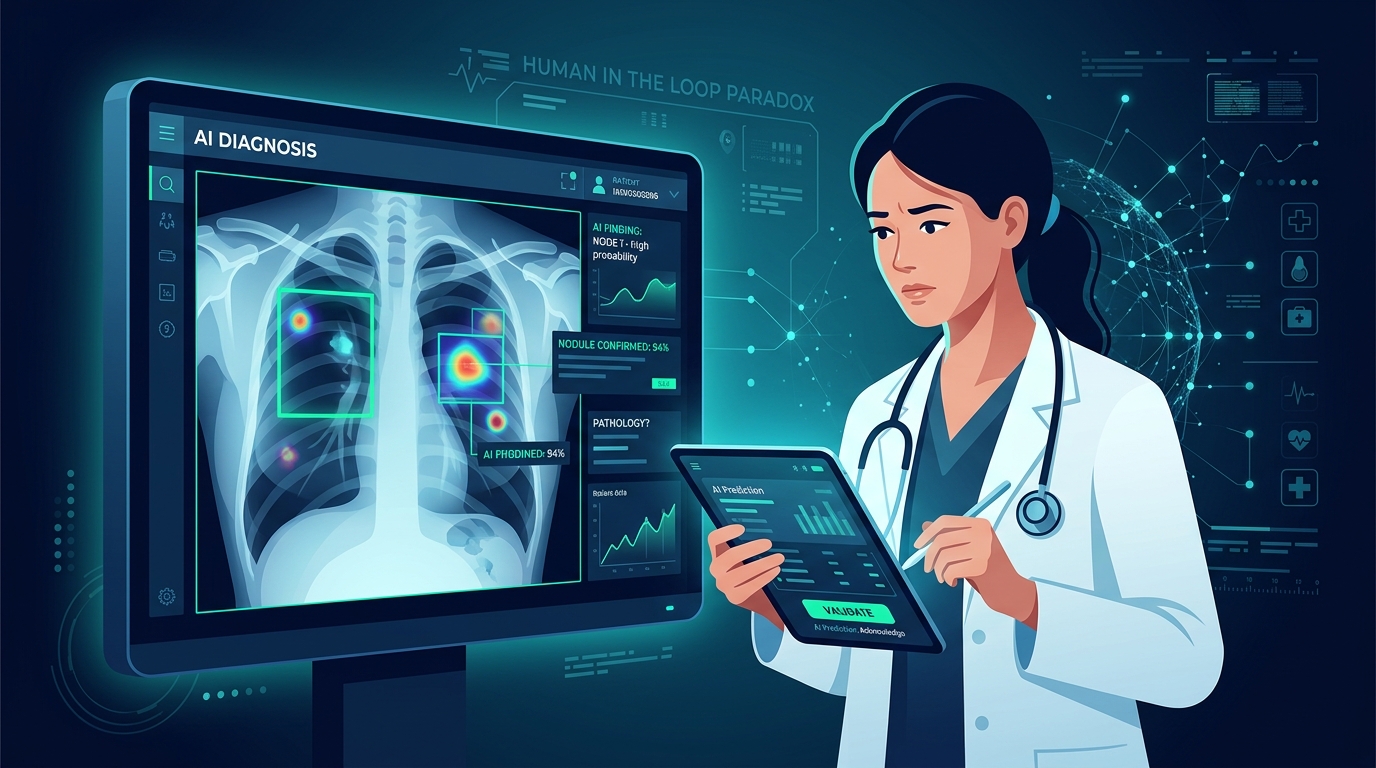
JAMA published a randomized clinical vignette survey study on AI-assisted diagnosis in acute respiratory failure. The study included 457 clinicians from 14 US states. Clinicians worked through clinical vignettes, and in some cases they received AI support for interpreting a chest radiograph. When the AI recommendation was systematically biased, diagnostic accuracy decreased. Importantly, image-based “explanations” did not sufficiently mitigate the effect. JAMA: Measuring the Impact of AI in the Diagnosis of Hospitalized Patients / PubMed
This is uncomfortable for anyone hoping that the problem can be solved with the phrase “human in the loop.”
Because a human in the loop is not automatically a human in control.
Sometimes the human is only there to lend legitimacy to the decision.
And this is exactly where EGA comfort appears: the person feels that responsibility formally remained with them, while psychologically it has been distributed across the person, the model, the vendor, the dataset, the interface, and the governance process.
The result? Nobody feels like the sole author of the decision.
Explainability does not help as much as we want it to
One of the most common defenses of AI systems is: “We will add explanations.”
But in practice, explanations often do not function as tools for critical thinking. They function as tools for trust.
A systematic evidence map of clinician-facing clinical decision support studies notes that explanations do not consistently improve decision quality, reliance calibration, or usability. The review also highlights that generic feature-attribution displays frequently showed limited incremental benefit beyond AI advice alone. InfoScience Trends: Explainable AI in Clinician-Facing Clinical Decision Support
This matters because explainability is often used as a moral safety mechanism.
“Don’t worry, the model explains itself.”
But an explanation can simply be better-packaged persuasion. If the person does not have the time, domain confidence, or motivation to challenge the recommendation, the explanation only lowers resistance.
The EGA mechanism is simple:
- AI gives a recommendation.
- The explanation creates a feeling of transparency.
- The person feels they performed due diligence.
- If something goes wrong, blame can be distributed: the recommendation was explained, the person reviewed it, the process was followed.
That is not control. That is a ritual of control.
Sense of agency: AI changes not only decisions, but also the feeling of authorship
A Scientific Reports study on the influence of AI behavior on moral decisions, agency, and responsibility is especially relevant here. The researchers found that interacting with AI influenced moral decision-making and changed participants’ explicit sense of responsibility. During interaction with AI, explicit responsibility decreased in morally challenging scenarios. Scientific Reports: Influence of AI behavior on human moral decisions, agency, and responsibility
This is where a technical debate about AI becomes a psychological one.
If a tool changes my output while also reducing my feeling that I authored that output, we have a problem. Not because AI carries legal blame. But because the person may start acting with fewer internal brakes.
When I feel like the author, I am more careful.
When I feel like the operator of someone else’s system, it becomes easier to say: “That is what came out.”
Diffused responsibility: ideal for the ego, bad for accountability
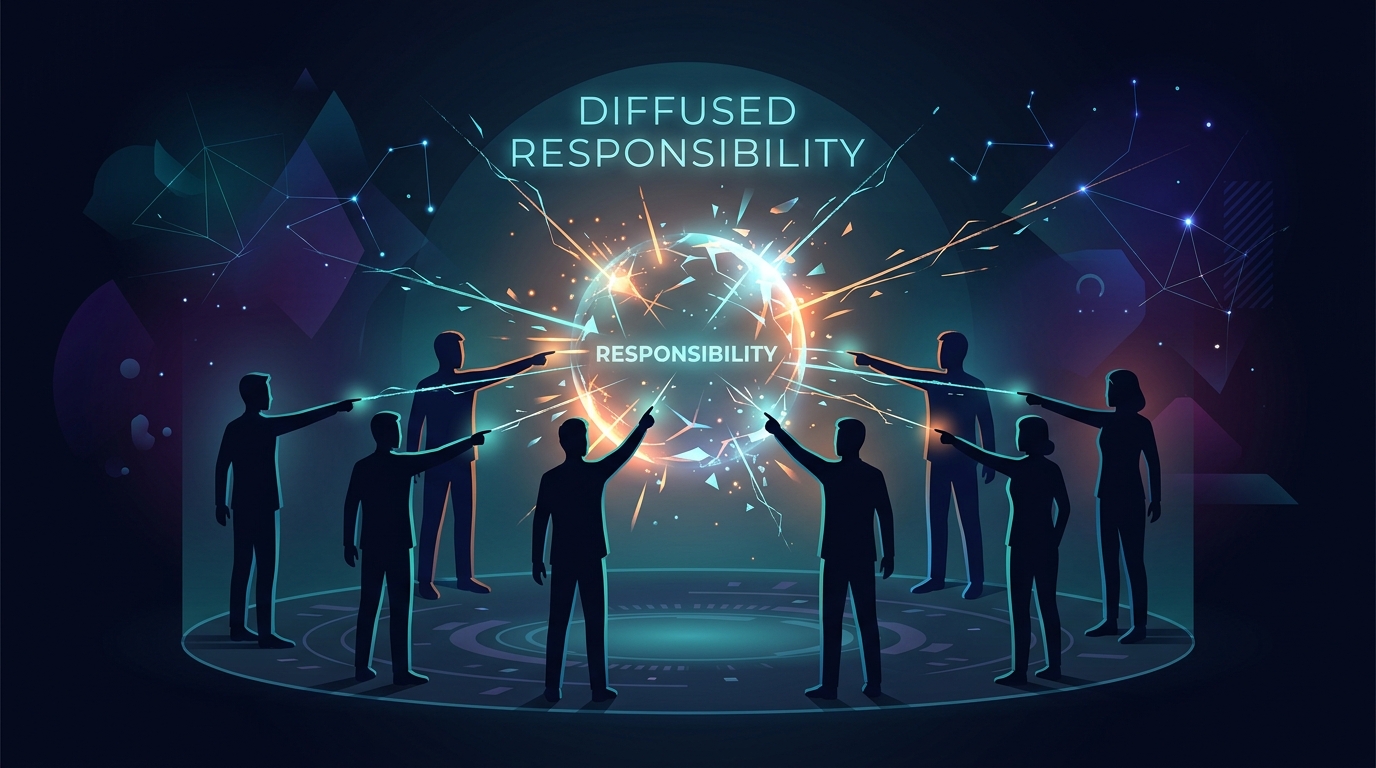
In the literature on AI-driven clinical decision support, the term diffused responsibility appears often. Bleher and Braun describe how, when AI is used in clinical decision-making, responsibility becomes distributed across the clinician, developer, institution, regulator, and the system itself. AI and Ethics: Diffused responsibility in AI-driven clinical decision support
Diffused responsibility is organizationally convenient, but morally dangerous.
Everyone has enough responsibility to say they were part of the process.
Nobody has enough responsibility to feel like the owner of the consequence.
For the ego, this is ideal. A person does not need to deny their role. They only need to make it smaller.
Not “I decided.”
But:
- “The AI recommended it.”
- “I validated it.”
- "The process allowed it."
- “The vendor guaranteed it.”
- “The organization approved it.”
- “The regulation permitted it.”
Each sentence may be partially true. Together, they can become an escape system.
Why this defense is so persuasive
Delegating responsibility to AI is easy to defend because it rests on four legitimate arguments.
1. AI often really does improve performance
It would be unfair to pretend that AI is only a risk. In many tasks, it improves speed, consistency, recall, triage, and decision support.
That is exactly why the defense is strong. If AI were obviously bad, nobody could hide behind it. A strong alibi needs a strong reason.
2. People often do not have the capacity to verify everything
In real systems, overload is normal. A clinician, developer, analyst, or manager does not have unlimited time to independently verify every suggestion.
AI enters environments where pressure toward shortcuts already exists.
3. “Human in the loop” sounds like responsibility
Formally, a person is still present. Psychologically, however, they may only be an approval mechanism.
If a person has 20 seconds, low confidence, and a system that appears persuasive, the “loop” is often just compliance decoration.
4. An AI error feels less personal than a human error
When a person is wrong, it feels like a failure of competence.
When AI is wrong, it feels like a system anomaly.
And a system anomaly hurts the ego less.
What this means for working with AI
The biggest risk is not that AI will decide for us.
The biggest risk is that AI will let us believe we are still deciding — while psychologically, we have already shifted responsibility elsewhere.
That is why it is not enough to ask:
Is the AI recommendation correct?
We also need to ask:
Who will feel like the author of the decision when the recommendation is wrong?
And even more directly:
Who will be required to say “this is my decision,” even though they used AI?
If we do not have a clear answer to that question, we do not have AI governance. We only have sophisticated alibis.
Conclusion: AI as a mirror of responsibility
AI did not eliminate human responsibility.
It only revealed how quickly we want to get rid of it when we are given a tool that looks sufficiently intelligent.
From the EGA perspective, delegating to AI is so easy because it protects the ego, reduces guilt, and blurs agency. A person can act without feeling like the sole origin of the action. They can make decisions while talking about recommendations. They can carry formal responsibility while emotionally distributing it across the system.
And that is why the most important sentence in AI should not be:
“The AI recommended it.”
It should be:
“I used AI, but the decision is mine.”
Sources
- PubMed - Automation Bias in AI-Decision Support: Results from an Empirical Study
- JAMA - Measuring the Impact of AI in the Diagnosis of Hospitalized Patients / PubMed
- InfoScience Trends - Explainable AI in Clinician-Facing Clinical Decision Support: A Critical Systematic Review and Evidence Map
- Scientific Reports - Influence of AI behavior on human moral decisions, agency, and responsibility
- AI and Ethics - Diffused responsibility: attributions of responsibility in the use of AI-driven clinical decision support systems