If It Works, That Doesn't Mean You Understand It
Developers must understand what is happening in the code, not just accept that "it works." AI can create an illusion of understanding.
AI has made one dangerous shortcut feel surprisingly normal:
"It works, so I must understand it."
That was never fully true. But before AI, the distance between writing code and running code was smaller. If you typed most of the implementation yourself, debugged it line by line, and fixed the weird edge cases manually, you usually picked up enough understanding along the way. Not always. But often enough that "it works" became a tempting proxy for "I know what is happening."
AI breaks that proxy.
Now you can get working code before you have built the mental model behind it. You can ask for a function, paste the answer, run the tests, see green, and feel the same reward loop you used to get after solving the problem yourself.
The result feels like understanding.
But it may only be familiarity.
You recognize the shape. You can explain the happy path. You know what the feature is supposed to do. You saw the code pass once.
That is not the same as understanding what happens when the input is malformed, when the network fails, when the state changes twice, when the dependency returns something unexpected, when the user does the one thing nobody put in the prompt.
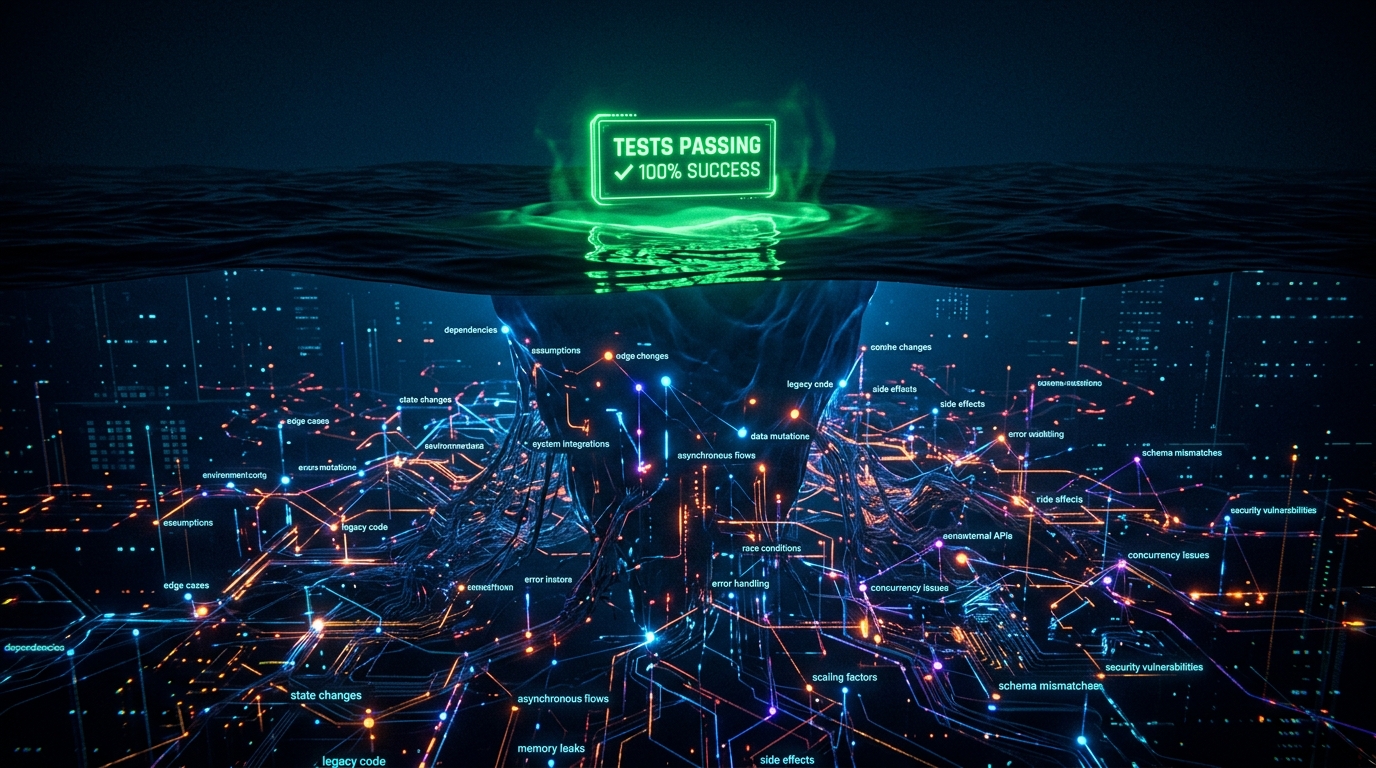
And this is where the debt starts accumulating.
At first, you only do not understand one generated helper. Then one abstraction. Then one data flow. Then one "small" architectural decision. Each piece works in isolation, so nobody stops. But over time, the system starts containing more code you can operate than code you can actually reason about.
That is the dangerous part.
Not that AI writes bad code.
That you can ship code you do not understand while feeling like you do.
Understanding is not optional
If code goes into the product, it becomes your responsibility.
Not the model's. Not the prompt's. Not the tool's. Yours.
You are responsible for what happens when it breaks. You are responsible for the edge cases. You are responsible for the security implications. You are responsible for whether the implementation matches the product intent. You are responsible for explaining it to the next developer, reviewing future changes, and deciding whether a bug is local or systemic.
AI can help you move faster, but it does not transfer accountability away from you.
This means "the AI generated it" is not an acceptable explanation for code you merged.
It can be part of the history. It cannot be the end of the reasoning.
A good engineer does not need to manually invent every line of code. But they do need to understand the code deeply enough to own it.
That means being able to answer:
- What problem does this solve?
- Why is this the right shape of solution?
- What are the important branches?
- What assumptions does it make?
- What happens when those assumptions fail?
- What trade-offs did we accept?
- What would we change if the requirements shifted?
- Where could this break in production?
- What parts are simple, and what parts are secretly fragile?
If you cannot answer those questions, the code is not truly yours yet.
Even if you pasted it.
Even if it compiles.
Even if the tests are green.
The old illusion got stronger
This illusion did not start with AI. AI just made it easier to scale.
Developers have always been able to mistake surface-level success for understanding. A feature works locally. A bug disappears after a refactor. A Stack Overflow answer fixes the error. A library handles the hard part.
The difference is that traditional development usually forced more friction into the process. You had to search, compare, adapt, debug, and integrate. That friction was annoying, but it also taught you things. It forced contact with the system.
AI removes a lot of that friction.
That is useful. It is also risky.
Because friction was doing educational work.
When the tool jumps directly from intent to implementation, you need to deliberately add the learning loop back in. Otherwise, the system improves while your understanding does not.
That gap is where future bugs live.
"It works" is only the first question
Working code answers one question:
Can this produce the expected result in at least one situation?
That is a useful question. It is not enough.
You also need to know:
- Why does it work?
- When does it not work?
- What does it depend on?
- What state does it mutate?
- What contract does it assume?
- What happens if the contract is violated?
- How would I debug it if it failed tomorrow?
- How would I safely change it in two months?
The more AI helps you generate code, the more disciplined you need to be about these questions.
Otherwise, you are not reducing complexity. You are outsourcing implementation while keeping complexity hidden.
And hidden complexity always comes back with interest.
The solution: make understanding explicit
The answer is not "stop using AI."
The answer is to stop treating generated code as complete when it merely works.
AI should not only be a code generator. It should also be a teacher, reviewer, and interrogation partner. After it helps produce a solution, it should help you prove that you understand the solution.
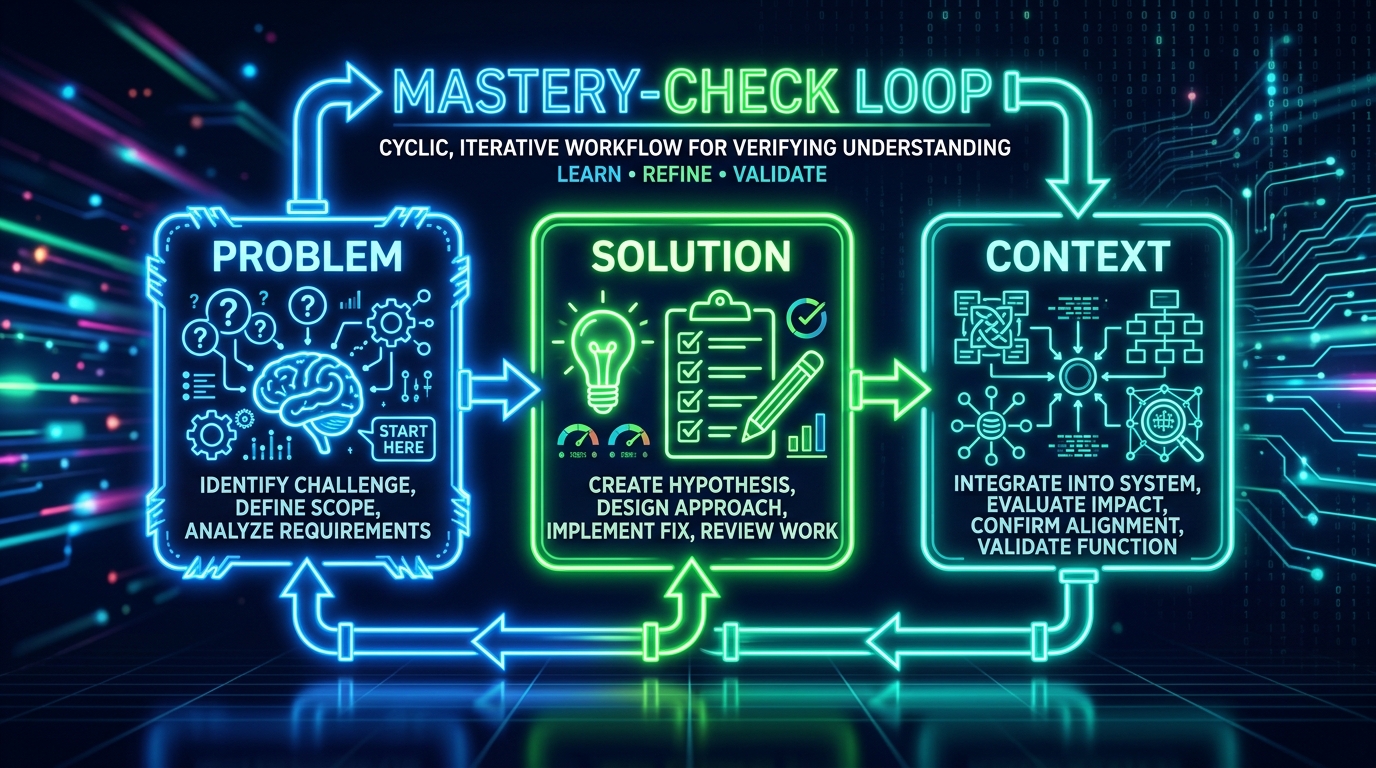
That means building a mastery loop into your workflow.
Before you move on, you should be able to explain the implementation at multiple levels:
-
The problem
- Why did this problem exist?
- What were the possible branches?
- What constraints shaped the solution?
- What would happen if we ignored it?
-
The solution
- Why was it solved this way?
- What design decisions were made?
- What edge cases matter?
- What are the failure modes?
-
The broader context
- Why does this matter?
- What parts of the system does it affect?
- What future changes could make this fragile?
- What should another developer know before touching it?
This is where the Teaching Walkthrough Driver — Mastery Checklist pattern is useful.
Instead of asking AI to explain everything at the end, you use it incrementally. Step by step. Before moving to the next part, you verify that you understand the current one.
Not with passive reading.
With active recall.
You restate what you think is happening. The AI points out gaps. You ask for ELI5, ELI14, or intern-level explanations where needed. You walk through edge cases. You answer open-ended questions. You debug small scenarios. You explain why the solution is shaped the way it is.
The goal is not to feel smarter.
The goal is to remove the parts of the implementation that you are only pretending to understand.
A practical workflow
After AI helps you write or modify code, do not immediately move on.
Run a short understanding check:
1. Restate the problem
Explain, in your own words:
- What problem were we solving?
- Why did it exist?
- What branches or cases were involved?
- What would break without this change?
If you cannot explain the problem, you are not ready to trust the solution.
2. Walk through the solution
Then explain:
- What changed?
- Why this design?
- What alternatives did we reject?
- What assumptions are built in?
- Which parts are business logic and which are technical plumbing?
If your explanation is just a paraphrase of function names, go deeper.
3. Drill into edge cases
Ask:
- What happens with empty input?
- What happens with invalid input?
- What happens on retry?
- What happens if two events happen quickly?
- What happens if the API returns partial data?
- What happens if this code runs in production scale?
This is where shallow understanding usually fails first.
4. Connect it to the system
Finally, zoom out:
- What else does this affect?
- What should tests cover?
- What logs or metrics would help debug it?
- What future requirement would stress this design?
- What should be documented for the next person?
This turns code from "working snippet" into "owned implementation."
AI should quiz you
One of the best uses of AI in coding is not asking it for the answer.
It is asking it to check your understanding.
For example:
"Quiz me on this implementation. Ask one question at a time. Do not reveal the answer until I respond. Focus on business logic, edge cases, and why this design was chosen."
Or:
"Here is my explanation of how this code works. Find the gaps in my reasoning."
Or:
"Act like a senior reviewer. What would you ask before allowing this to be merged?"
This changes the relationship.
The AI is no longer just producing output. It is helping you earn ownership of the output.
That difference matters.
Because the real risk is not that juniors will use AI. The real risk is that anyone — junior, mid, or senior — will start accepting correct-looking code without doing the mental work required to maintain it.
The standard should be higher now
AI makes it easier to produce code.
So the standard for understanding should go up, not down.
If implementation becomes cheaper, reasoning becomes more valuable. If code is generated faster, review needs to become sharper. If solutions appear instantly, engineers need stronger habits for asking "why this?" and "what breaks?"
The future does not belong to developers who can generate the most code.
It belongs to developers who can build, verify, explain, and evolve systems responsibly — with or without AI.
That starts with a simple rule:
If you merge it, you own it.
And if you own it, you need to understand it.
Not just that it works.
Not just what it does on the happy path.
Not just what the AI said it does.
You need to understand what is happening in the code.
That is still your responsibility.